

Speech-in-Noise Tests: What They Measure and Why They Matter
Imagine this scenario for a moment. You are sitting at a favourite local restaurant in Waterloo, catching up with friends. The food is excellent, the company is wonderful, but there is a problem. The background chatter, the clinking of cutlery, and the upbeat music are creating a dense wall of sound. You can hear your friends talking, but understanding their actual words feels like trying to decipher a secret code. Eventually, you just start nodding and smiling, hoping you did not just agree to foot the bill. Have you ever found yourself in a similar situation?
Many folks pass a basic hearing test in a quiet room with flying colours, yet they still feel entirely frustrated in real-world listening situations. They know they can hear sounds, but the clarity is missing when life gets noisy. The truth is, understanding speech is a complex brain function, and background noise acts like static on a radio dial.
Speech-in-noise tests are specifically designed to measure how well you understand speech when competing background noise is present. These tests can help reveal hidden listening challenges that may not appear clearly during standard clinical evaluations conducted in silent booths. This comprehensive guide will explain exactly what speech-in-noise tests measure, why they matter so much for your day-to-day life, what the results can show, and when it is time to book a professional hearing assessment.
Key Takeaways
- Real-World Reflection: Speech-in-noise testing mimics everyday environments, providing a much more accurate picture of your daily communication struggles than testing in a silent room.
- Beyond Volume: Hearing is about detecting sound, but listening is about understanding. These tests measure speech clarity and cognitive load.
- Targeted Solutions: Results directly guide the selection and customization of hearing technology, ensuring you get the right support for noisy situations.
- Local Support: Discover Hearing Centre offers personalized, comprehensive evaluations right here in the Waterloo Region to get to the root of your listening challenges.
What Is a Speech-in-Noise Test?
If you are wondering, “What is a speech-in-noise test?” the simplest definition is that it is a specialized hearing assessment that measures how well a person understands speech in the presence of competing background noise. We do not live in soundproof booths. We live in a vibrant, noisy world. This test replicates those everyday auditory environments to see how your brain handles the heavy lifting of sorting voices from noise.
Common examples of background noise that make this test so relevant include:
- Restaurant noise and the clatter of dishes
- Group conversations where multiple people are talking at once
- Traffic sounds during a daily commute
- Office noise, including typing and ringing phones
- Television or music playing in the background at home
- Family gatherings and holiday dinners
- Public spaces like grocery stores or community centres
A speech-in-noise hearing test is often a vital part of a more comprehensive hearing evaluation, especially when someone reports difficulty understanding speech in their normal, everyday environments.
What Do Speech-in-Noise Tests Measure?
It is easy to assume that a hearing test just checks if your ears are working. However, these specific tests measure speech understanding, not just the physical ability to detect a sound. They evaluate the brain’s ability to process and filter information.
During a speech recognition in noise evaluation, several key factors are measured:
- How clearly someone understands words or sentences when enveloped by background noise.
- How much louder the speech needs to be compared to the noise for the person to understand it. This is often referred to as the signal-to-noise ratio.
- How well the brain actively separates the primary speech signal from competing sounds.
- How much listening effort or cognitive load might be needed to function in noisy places.
- Whether speech clarity problems are present even when basic hearing thresholds seem mild or close to normal.
- How these specific hearing challenges directly affect real-world communication and socialization.
How Speech-in-Noise Testing Is Different From a Standard Hearing Test
To truly grasp the value of a speech clarity test, it helps to understand how it contrasts with the traditional methods you might already know.
Standard Hearing Tests
A standard hearing test often measures the softest tones a person can detect across various pitches. This usually happens in a very quiet, controlled testing environment. The primary goal is to help identify the type and degree of hearing loss, whether it is sensorineural hearing loss, conductive hearing loss, or a mix of both. The results are commonly shown on a graph called an audiogram, which is wonderfully useful for understanding your baseline hearing sensitivity.
Speech-in-Noise Tests
On the flip side, speech-in-noise tests measure your speech understanding in background noise. Because they introduce a competing sound signal, they more closely reflect real-world listening challenges. This makes them an excellent real-world hearing test. They help assess actual speech clarity and overall communication ability, and they can reveal auditory processing problems that are simply not obvious during quiet testing. Ultimately, this helps guide far more personalized hearing care recommendations.
Why Both Tests Matter
Standard testing shows what sounds a person can detect, acting as the foundation of your auditory profile. Speech-in-noise testing shows how well the person communicates in noisy settings, acting as the practical application of that profile. Together, they provide a much broader picture of your overall hearing health. Both results can strongly support better patient counselling, tailored treatment planning, and informed decisions about hearing technology.
Why Speech Understanding in Noise Is So Difficult
Why does a little bit of chatter make it so hard to hear the person sitting right across from you? It boils down to a mix of physics, biology, and brain power.
Background Noise Competes With Speech
Noise can quite literally cover up parts of speech. Think of it like trying to read a letter where someone has spilled coffee over half the words. Similar-sounding words become harder to separate, and conversations may suddenly sound muffled or entirely unclear. Because the auditory signal is compromised, the brain has to work much harder to fill in the missing information using context clues.
High-Frequency Hearing Loss Can Affect Clarity
High-frequency sounds act as the crisp edges of speech. Consonant sounds like “s,” “f,” “th,” and “sh” reside in these higher frequencies and carry the meaning of many words. If you have high-frequency hearing loss, speech may be audible but not clear. You might hear the vowel sounds perfectly, knowing someone is talking, but miss the consonants that tell you what they are actually saying. Naturally, adding background noise can make these difficulties significantly worse.
Listening Effort and Fatigue
Struggling to understand speech can be deeply, mentally tiring. When noisy settings require extra concentration just to keep up, your brain is burning a lot of energy. This phenomenon is known as listening fatigue. Over time, people may start to avoid social situations altogether because listening just feels exhausting. A proper speech audiometry test can help explain these real-life challenges and validate the exhaustion you might be feeling after a simple dinner party.
Who Should Consider a Speech-in-Noise Test?
Are you wondering if this type of evaluation is right for you? There are several clear indicators that a hearing test for speech clarity is a smart next step. You should consider booking an appointment if:
- You hear people talking, but cannot understand them clearly.
- You consistently struggle in restaurants, meetings, or group conversations.
- You frequently need people to repeat themselves in noisy places.
- You feel tired or drained after social events because listening takes so much effort.
- You find yourself avoiding busy environments because hearing is just too difficult.
- You experience tinnitus and find it makes it difficult to focus on speech.
- You already have hearing aids, but still struggle in background noise.
- Your recent hearing test seems “normal,” but daily conversations are still a major hurdle.
- Family members or friends notice that you often miss parts of conversations.
If any of this sounds familiar, it is wise to act. We encourage readers to book a professional hearing assessment if speech-clarity issues are affecting their daily lives.
How Speech-in-Noise Testing Is Performed
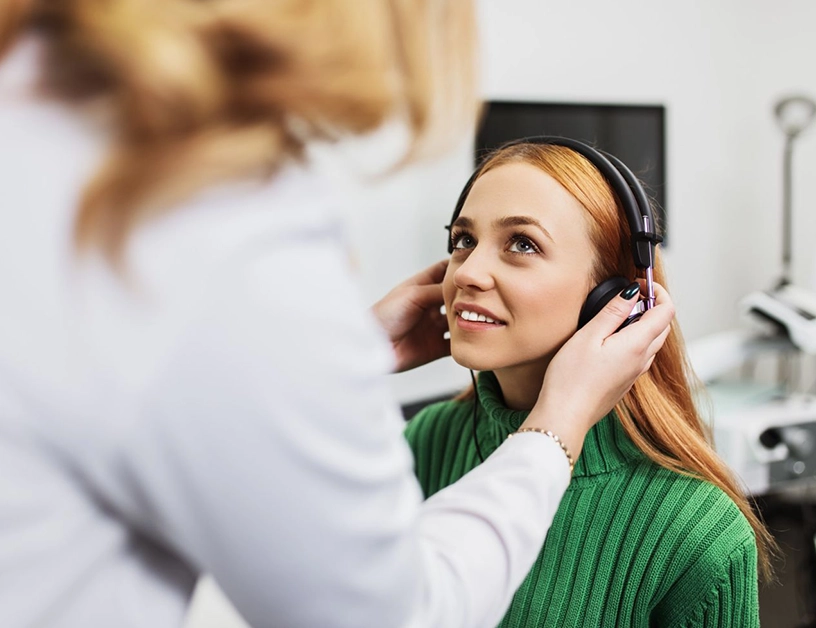
The process is straightforward, painless, and very insightful. During the test, the person listens to specific words, numbers, or full sentences. Simultaneously, a layer of background noise is added to the listening environment.
As the test progresses, the speech and noise levels may change to test your limits. You will be asked to repeat what you heard. Your responses are then scored to accurately measure your speech understanding under these specific conditions. These results may show exactly how much difficulty the person has in noise compared to the average listener.
Depending on the clinic’s setup and your specific needs, the test may be completed with headphones or through calibrated room speakers. Testing should always be conducted in a controlled clinical environment under the guidance of a hearing care professional to ensure the most reliable, medically accurate results.
What Speech-in-Noise Test Results Can Reveal
Once the testing is done, the data provides a treasure map to your auditory system. Here is what we look for.
Speech Clarity Challenges
The results can highlight a distinct difficulty in understanding words, even when the sound is loud enough. They point out trouble separating speech from background noise and can explain a reduced confidence in conversations. Most importantly, they highlight problems that may not show fully in quiet testing.
Listening Effort
We can gauge the extra mental effort needed to follow speech. If you experience listening fatigue in social or work settings, struggle to keep up with fast-paced conversations, or feel increased frustration in group environments, the test results often provide clinical evidence for why that is happening.
Hearing Technology Needs
This data is crucial for exploring whether hearing aids may help improve communication. It also shows whether current hearing aid settings may need adjustment, whether specific noise-reduction or directional-microphone features may be helpful, and whether additional communication strategies may be needed for your lifestyle.
Why Speech-in-Noise Testing Matters for Hearing Aid Recommendations
Investing in hearing technology is a big step, and guesswork has no place in the process. Speech-in-noise testing results can help precisely guide hearing aid selection. Because every manufacturer handles noise differently, knowing your specific deficit helps your specialist choose the best tool for the job.
The results may support more personalized programming and help set realistic expectations for your hearing rehabilitation journey. A test can clearly show whether background noise is a major concern for you and may help identify the need for advanced directional microphone features. It also serves as an excellent foundation for patient counselling on communication strategies and can help you measure your improvement over time. Hearing aids for background noise can help many people, but performance always depends on the individual hearing profile, the technology chosen, the listening environment, and your personal goals.
Can Speech-in-Noise Testing Help If You Already Wear Hearing Aids?
Absolutely. The test can be incredibly useful for current hearing aid users who still struggle in noisy places. Hearing needs can change, and technology often needs fine-tuning.
Testing helps identify whether your hearing aid programming/settings need a thorough review. It clearly shows how well speech is being understood in noise right now, supporting targeted adjustments based on your real-world concerns. It helps explain why some environments remain difficult despite the use of devices. Furthermore, the results may guide accessory or assistive listening recommendations, such as remote microphones. Ultimately, it provides a solid baseline for future comparison and helps improve counselling and communication strategies.
What Happens If Speech-in-Noise Problems Are Ignored?
Ignoring difficulty hearing in background noise rarely makes the problem go away. In fact, leaving it unaddressed often leads to a snowball effect of negative outcomes.
Ongoing communication frustration is usually the first sign. This quickly leads to avoiding restaurants, meetings, or family gatherings. Increased listening fatigue sets in, causing frequent misunderstandings in conversations. Over time, you might experience reduced confidence at work or socially, which can create a noticeable strain in relationships with loved ones. All of this contributes to a lower quality of life. Delayed hearing care is a common pitfall. Some people wait too long simply because they can hear well in quiet spaces and incorrectly assume their hearing is fine.
When Should You Book a Professional Hearing Assessment?
Taking action is the first step toward reclaiming your social life. You should book a professional hearing assessment if you notice any of these clear signs:
- You regularly struggle to hear in background noise.
- Conversations sound unclear even when the volume is loud enough.
- You frequently ask people to repeat themselves.
- You find yourself avoiding noisy social settings.
- You feel mentally tired after listening for extended periods.
- You have tinnitus paired with speech clarity concerns.
- You have hearing aids, but still struggle in noisy environments.
- Online hearing test results do not match your real-life experiences.
- Family or coworkers notice your communication difficulties.
If you are looking for a reliable hearing assessment in Kitchener or a thorough hearing assessment in Waterloo, we encourage you to schedule an in-clinic appointment for accurate, personalized answers.
Preventing Future Communication Difficulties
While we cannot control every noisy environment we walk into, we can take proactive steps to protect our ability to communicate.
Schedule routine hearing assessments to stay ahead of any changes. Address speech clarity concerns early rather than waiting for them to worsen. Always protect your ears from loud noise by wearing hearing protection in noisy environments, such as concerts or construction sites. Avoid ignoring tinnitus or muffled hearing, as these are often early warning signs. Keep your hearing devices well-maintained if you already use them.
During your appointments, be sure to share your real-world listening struggles so your specialist has the full picture. Practice active communication strategies in noisy settings, such as facing the speaker and finding well-lit areas to converse. Finally, consistently monitor any changes in your hearing over time.
How Discover Hearing Centre Can Help
Discover Hearing Centre is a locally owned hearing clinic proudly based in Kitchener, serving patients from Waterloo, Cambridge, and communities right across the Waterloo Region. We are dedicated to helping people understand the underlying hearing concerns that affect their real-world communication, including the specific difficulty of understanding speech in background noise.
Our team features experienced hearing care professionals who are deeply focused on accurate testing, clear explanations, and compassionate support. We offer comprehensive hearing evaluations for people experiencing speech-clarity concerns, tinnitus, muffled hearing, listening fatigue, or difficulty hearing in restaurants, meetings, and group conversations.
We provide access to advanced hearing technology and offer personalized recommendations based directly on each patient’s unique test results, lifestyle, common listening environments, and communication needs. Beyond devices, we offer ongoing guidance on hearing aids, hearing protection, communication strategies, follow-up care, and long-term hearing wellness. We pride ourselves on patient-focused care designed to improve your speech understanding, boost your communication confidence, maintain your independence, and enhance your overall quality of life.
Bringing It All Together: Your Path to Clearer Conversations
Hearing well is about more than just sensing sound; it is about connecting with the people around you. When background noise turns a fun outing into a stressful chore, it is a clear sign that your brain and ears are struggling to process competing signals. Speech-in-noise tests take the guesswork out of the equation. By measuring exactly how well you understand speech in noisy environments, we can uncover hidden challenges, reduce your daily listening fatigue, and tailor hearing solutions that genuinely fit your life. You do not have to sit on the sidelines of your own conversations. With the right testing and a personalized approach to care, you can get back to enjoying every busy restaurant, family dinner, and social gathering with confidence.
Book a Professional Hearing Assessment at Discover Hearing Centre: Get Clearer Answers About Hearing Speech in Noise

You Might Also Like

Why Diabetics Should Include a Hearing Test in Their Annual Health Routine
Invisible Hearing Aids: Pros, Cons, Cost, and Who They’re Best For
Can You Trial Hearing Aids Before Buying? What to Know and Ask
Take the First Step Toward Better Hearing
Schedule a Hearing Test Today
Have Questions?
Curious about hearing loss, tinnitus relief, or treatment options in Waterloo? Talk to one of our hearing care professionals today.