

Online Hearing Tests vs. In-Clinic Testing: Are They Accurate?
Picture this: you are settling in to watch your favourite television show, but the dialogue sounds a bit muddy. You nudge the volume up a few notches. Maybe you have recently asked a colleague to repeat themselves during a meeting, or phone calls sound like everyone is mumbling. These little moments often spark a familiar question: “Is it my hearing, or is everyone just speaking softly these days?”
When faced with that uncertainty, it is entirely natural to look for a quick answer. Typing “hearing test online” into a search engine feels fast, private, and convenient. Let’s face it, looking into free online hearing test accuracy seems like an easy first step. But how much can a digital screening really tell you?
While an online hearing test can be a helpful starting point, it is not quite the same as an in-person, in-depth evaluation. Digital results are easily skewed by the quality of your headphones, background noise, device volume, room acoustics, and the specific type of test you are taking. In this guide, we will explore exactly how these tools work, investigate online hearing test accuracy, and weigh online hearing tests vs in-clinic testing so you can make informed decisions. We will also help you figure out exactly when to book a hearing test with a professional.
Key Takeaways
- Convenience vs. Precision: Online tests are quick and private but offer only a basic screening, not a concrete medical diagnosis.
- Equipment Matters: Your results at home rely heavily on your specific headphones, device volume, and room acoustics.
- Missing the Full Picture: Digital tools can miss one-sided hearing changes, underlying medical issues, or physical blockages.
- Professional Expertise: An in-clinic hearing test provides a controlled environment, calibrated equipment, and a tailored treatment plan designed just for you.
What Is an Online Hearing Test?
An online hearing test is a digital hearing screening that you can complete through a website, smartphone app, or online tool. Most of these platforms ask you to listen to tones, everyday sounds, numbers, or speech through your headphones and click a button when you hear something.
These tests are designed to provide a general indication of possible hearing difficulty rather than a firm diagnosis. If you are comparing an online hearing test vs. a professional hearing test, it helps to know what digital tools actually measure. Common online hearing test formats include:
- Tone-based hearing checks: Playing beeps at different pitches to find your hearing thresholds.
- Speech-in-noise tests: Asking you to identify spoken words over background chatter.
- Number recognition tests: Having you type out digits spoken at varying volumes.
- Questionnaire-style hearing screenings: Asking about your day-to-day listening environments and struggles.
- App-based hearing checks: Utilizing your smartphone to run a quick hearing loss test.
What Happens During an In-Clinic Hearing Test?
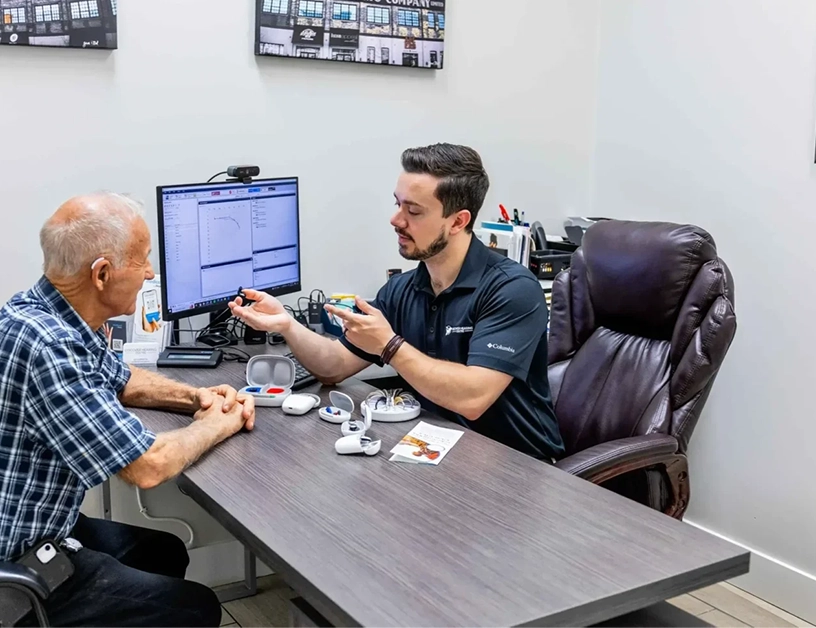
Stepping into a hearing evaluation clinic provides a much more comprehensive and controlled evaluation of your hearing health. Testing is completed in a professional setting using specialized equipment and a calibrated testing environment. This ensures the data collected is exact and reliable.
During your visit, the assessment will likely involve:
- A thorough review of your hearing concerns and medical history.
- An ear examination to check the physical health of your ear canal and eardrum.
- Pure-tone testing to pinpoint the quietest sounds you can hear across different pitches.
- Speech testing to evaluate your speech clarity and recognition.
- Speech-in-noise testing to see how well you follow conversations in crowded places.
- Middle ear checks when needed to ensure the mechanics of your ear are functioning properly.
- A detailed review of your results plotted on an audiogram.
- Personalized recommendations based on the findings, tailored to your specific lifestyle.
Are Online Hearing Tests Accurate?
So, are online hearing tests accurate? The short answer: they can provide a basic indication of your hearing ability, but their accuracy is strictly limited.
An online hearing screening may help you decide whether you should book a full evaluation. However, can you trust online hearing tests implicitly? No. They should not be used as your only source of information, especially if you have symptoms like sudden hearing changes, tinnitus, dizziness, ear pain, or real difficulty understanding speech.
You have to consider several online hearing test limitations:
- Background noise can easily affect your results.
- Headphone quality can drastically change how sound levels are delivered.
- Device volume may not be calibrated to industry standards.
- Room acoustics can interfere with the testing process.
- Internet or app quality may vary, causing glitches or sound delays.
- These tests may not detect all types of hearing loss.
- Favourable results may create false reassurance, masking a subtle issue.
- Poor results might create unnecessary worry over a technical glitch.
Why Online Hearing Test Results Can Be Misleading
Background Noise and Room Acoustics
Home environments are simply not controlled testing spaces. The hum of your refrigerator, traffic outside your window, family conversations, fans, pets, or even a slight room echo can interfere with the audio, making your hearing seem worse than it actually is.
Headphone or Speaker Quality
Different headphones and speakers produce sound differently. If you are using low-quality earbuds or laptop speakers, they may not deliver the accurate tones or speech sounds required to give you an accurate hearing test result.
Device Volume and Calibration Issues
Online tests cannot always confirm whether your device volume is set correctly for a clinical assessment. Sound levels vary wildly between phones, tablets, laptops, and desktop computers, making accurate sound calibration virtually impossible outside a clinic.
Online Hearing Tests vs. In-Clinic Testing: Key Differences
Accuracy
When it comes down to it, online tools provide a general hearing screening. In contrast, in-clinic testing provides precise, accurate, and detailed results. A hearing specialist uses calibrated equipment to map exactly what is happening in your auditory system.
Testing Environment
Online tests are completed at home, where noise, room acoustics, and daily interruptions can easily alter the outcome. In-clinic tests are conducted in a controlled testing environment, often inside a soundproof booth, ensuring that the only thing being measured is your actual hearing ability.
Personalized Recommendations
Online tools usually offer generic advice based on limited data. In-clinic testing considers your specific symptoms, lifestyle, communication needs, and detailed test findings. Patients leave with clear next steps based on their unique hearing profile. These recommendations might include hearing protection, ongoing monitoring, exploring hearing technology, or a medical referral if needed.
When Online Hearing Tests Can Be Helpful
Despite their limitations, digital tools certainly have their place. They can be quite helpful in specific scenarios:
- As an early, low-pressure screening tool.
- When you are unsure whether your hearing has actually changed.
- For individuals who feel hesitant to book an official appointment right away.
- To start a productive conversation about hearing health with a loved one.
- To encourage earlier testing and intervention.
- To monitor general hearing concerns loosely over time.
When You Should Not Rely on an Online Hearing Test
There are certain red flags where a digital screening is simply not enough. You should bypass the apps and seek professional care if you experience any of the following:
- Sudden hearing loss.
- Hearing loss in only one ear.
- Ringing, roaring, or buzzing in the ears (tinnitus).
- Dizziness or balance problems.
- Ear pain or visible drainage.
- A feeling of ear fullness or intense pressure.
- Significant difficulty understanding speech, even in quiet settings.
- Hearing changes after a loud noise exposure.
- Hearing changes following an illness or head injury.
- Online test results that simply do not match the real-life symptoms you are experiencing.
If these symptoms persist or concern you, we strongly encourage you to book an in-person assessment.
Why In-Clinic Hearing Testing Is More Complete
A professional environment simply offers more reliable testing conditions. An in-person visit allows your hearing care professional to check both ears separately and obtain a more accurate measure of your true hearing thresholds. It allows for advanced speech-clarity testing, a full review of your symptoms and lifestyle concerns, and the identification of possible medical red flags.
Furthermore, a professional can provide tangible guidance on hearing aids or other solutions, if needed, and offer steadfast support for your long-term hearing wellness. A proper assessment can also distinguish nerve-related hearing loss from issues that may seem similar but have simple fixes. For instance, what feels like a permanent drop in hearing might just be impacted earwax that requires safe earwax removal.
What Types of Hearing Problems Can Online Tests Miss?
Because digital tools are limited in scope, they routinely miss crucial diagnoses. A hearing screening test on your phone might overlook:
- Mild hearing loss.
- High-frequency hearing loss (often the first pitch range to fade).
- Specific speech clarity problems.
- Hearing difficulty that only happens in background noise.
- One-sided hearing loss.
- Conductive hearing loss (issues with the middle or outer ear) versus sensorineural hearing loss (inner ear or nerve issues).
- Earwax-related hearing changes.
- Tinnitus-related concerns.
- Middle ear problems, like fluid or an ear infection.
- Medical red flags requiring further evaluation by a physician.
It is entirely possible to pass an online screening but still struggle to follow real conversations at a busy restaurant.
How to Prepare for an Accurate Hearing Assessment
Taking the step to book an in-person visit is a great move for your overall health. To get the most out of your appointment, consider these practical tips:
- Write down your specific hearing symptoms before you arrive.
- Note exactly when those symptoms started.
- Mention any instances of tinnitus, dizziness, ear pain, or ear pressure.
- Bring a list of your current medications, as some can affect hearing.
- Share your noise exposure history, including noisy jobs or loud hobbies.
- Explain your real-life listening challenges (e.g., struggling at family dinners).
- Ask about custom hearing protection if you are frequently exposed to loud sounds.
- Bring a family member or caregiver if it helps you feel comfortable and provides a secondary perspective on your hearing habits.
How Discover Hearing Centre Can Help
Discover Hearing Centre proudly serves the Waterloo Region, providing professional hearing assessments in Kitchener, Waterloo, and nearby areas. If you have been searching for a reliable hearing test in Kitchener or Waterloo, we are here to help you understand your hearing changes with precise testing, clear explanations, and unwavering, personalized support.
Our experienced hearing specialists are focused on accurate hearing loss diagnosis and compassionate care. We offer robust in-clinic testing for people experiencing muffled hearing, tinnitus, speech clarity issues, or gradual auditory changes. We utilize advanced hearing technology to formulate personalized recommendations based entirely on your results, lifestyle, and unique communication needs.
Beyond the test itself, we offer expert guidance on hearing protection, the latest hearing aids, dedicated follow-up care, and long-term hearing wellness strategies. Our patient-focused approach is designed to solve your hearing challenges, improve your daily communication, boost your confidence, and elevate your overall quality of life.
The Final Word on Your Hearing Health Journey: Clarity Awaits
Navigating changes in how you hear the world can feel a bit overwhelming, but you do not have to figure it out alone through a smartphone app. While an online screening is a great way to dip your toes in the water, it is really just the tip of the iceberg. To truly understand your auditory health, distinguish between different types of hearing loss, and find a lasting solution tailored to your life, an in-person assessment is unmatched. From exploring advanced hearing technology to simple wax removal, taking that step ensures you get the real answers you deserve.
Book a professional hearing assessment at Discover Hearing Centre.
Get Accurate Answers About Your Hearing Health

You Might Also Like
Why Diabetics Should Include a Hearing Test in Their Annual Health Routine
Invisible Hearing Aids: Pros, Cons, Cost, and Who They’re Best For
Can You Trial Hearing Aids Before Buying? What to Know and Ask
Take the First Step Toward Better Hearing
Schedule a Hearing Test Today
Have Questions?
Curious about hearing loss, tinnitus relief, or treatment options in Waterloo? Talk to one of our hearing care professionals today.