


Is It Hearing Loss or Just a Blocked Ear? A Diagnostic Guide You Can’t Ignore
Muffled hearing can feel harmless at first. It is often a sensation similar to water trapped in your ear after a shower or a mild case of earwax buildup that you assume will clear up on its own. You might find yourself shaking your head, tugging on your earlobe, or waiting for that satisfying “pop” that signals relief. In some cases, the same sensation may indicate actual hearing loss, including conditions that require urgent attention.
Many people delay testing because they assume hearing will return on its own. They convince themselves it is just a bit of congestion or perhaps the aftermath of a cold. This guide explains how to tell the difference between a blocked ear and hearing loss, what your symptoms may indicate, and when ignoring the signs can lead to permanent damage. It is about moving from guessing to knowing.
Key Takeaways
- Timing Matters: Sudden hearing loss is a medical emergency and is often mistaken for a simple blockage. If it happens instantly, seek help immediately.
- The “Mumble” Factor: True hearing loss often affects clarity rather than volume, making it seem like people are mumbling, whereas a blockage feels like the volume has been turned down.
- Safety First: Never use cotton swabs to try to clear a blockage. You risk further impacting the wax or damaging the eardrum.
- Professional Diagnosis: Only a comprehensive hearing test can accurately distinguish between a physical blockage (conductive loss) and nerve damage (sensorineural loss).
Start With This Question. Did Your Hearing Change Suddenly or Gradually?
When you are trying to determine the root cause of your hearing issues, the timeline is your most valuable clue. Did you wake up one morning with a “dead” ear, or have you been slowly turning up the volume on the television over the last few years?
Sudden hearing loss is a significant red flag. If your hearing drops off suddenly or over a few days, it requires immediate attention. Many people make the mistake of assuming a sudden drop is just a wax plug that shifted. While that is possible, sudden sensorineural hearing loss (SSHL) mimics that same “plugged” sensation but involves the inner ear nerve. We will discuss this more later, but the rule of thumb is simple: if it is sudden, do not wait.
Gradual hearing changes, on the other hand, are the hallmark of age-related hearing loss (presbycusis) or noise-induced damage. This feels more like a dimmer switch being slowly lowered, so you barely notice the room getting darker. You might blame the acoustics of a restaurant or the mumbling of your grandchildren long before you suspect your own ears.
When we see patients at our centre, we also look at whether the issue is in one ear versus both ears. A blocked ear due to wax or infection is often unilateral (one-sided). Age-related hearing loss almost always affects both ears, though it may be slightly worse in one. If you have a blockage in both ears at the same time, it is often associated with a systemic issue, such as a head cold or severe allergies.
What Does a Blocked Ear Usually Feel Like?
We often describe a blocked ear as a “conductive” issue. This means sound waves are physically being stopped from travelling through the outer or middle ear to the inner ear. Think of it like a plumbing issue where a pipe is clogged.
The most common characteristic is a sensation of fullness or pressure. It feels physical. You might feel like you need to “clear” your ears, similar to the sensation you get when an airplane descends.
Another telltale sign is a hollow or underwater sound quality. Your own voice might sound loud and booming in your head, a phenomenon known as the occlusion effect. It is the same sensation you get if you stick your fingers in your ears and speak. External sounds, however, will seem muffled or distant.
Fluctuating hearing levels are also common with blockages. If you have fluid behind the eardrum, your hearing might change based on your head position. You might hear better when lying down than when standing up. Similarly, sensations that change when swallowing or yawning often point to the Eustachian tubes. If popping your ears provides a split second of clarity before fading back to muffled, you are likely dealing with a pressure or fluid issue.
Typical causes for this sensation include:
- Earwax buildup (cerumen impaction): The most common culprit.
- Fluid behind the eardrum: Often leftover from a cold or infection.
- Sinus congestion or allergies: Inflammation can close off the tubes that ventilate the ear.
- Pressure changes: Occurring after flying, driving through hilly terrain, or illness.
Also Read: 7 Questions to Ask Before Booking a Hearing Test
What Hearing Loss Feels Like and Why It Is Often Misread
True hearing loss, specifically sensorineural hearing loss, feels quite different from a mechanical blockage. It is rarely painful, and there is usually no sensation of pressure. Instead of a volume problem, it is primarily a clarity problem.
The early signs of hearing loss are subtle. You might notice you have difficulty understanding speech, particularly in environments with competing background noise. It is not that you cannot hear the voices; it is that you cannot distinguish the words. It sounds like everyone has a marble in their mouth.
You may find yourself having trouble following conversations in noisy settings, such as busy restaurants or family gatherings. You might be the one increasing the volume on television or your phone to levels others find uncomfortable. Or perhaps you are frequently asking people to repeat themselves, blaming their enunciation rather than your auditory system.
Why is this so often misread? The brain adapts to gradual changes. Because the decline happens over years, your brain works overtime to fill in the blanks using context clues and lip-reading. You do not realize how much energy you are expending just to keep up.
Furthermore, there is often no pain or pressure. Because nothing hurts and your ears do not feel “stuffed,” you assume everything is physically fine. Early loss is commonly mistaken for background noise issues. It is easier to say “this restaurant is too loud” than to admit “I am having trouble hearing.”
Blocked Ear vs Hearing Loss. Key Symptom Differences
To help you navigate these symptoms, we have broken down the distinctions. While this does not replace a professional diagnosis, it provides a framework for understanding what you are experiencing.
| Feature | Blocked Ear (Conductive) | Hearing Loss (Sensorineural) |
| Onset | Often sudden or over a few days. | Usually gradual (except SSHL). |
| Physical Sensation | Pressure, fullness, pain, or “plugged” feeling. | No physical sensation; ear feels normal. |
| Sound Quality | Muffled volume; own voice sounds loud/booming. | Distorted clarity; speech sounds like mumbling. |
| Consistency | Can fluctuate (popping, shifting). | Consistent; does not change day-to-day. |
| Tinnitus | Low-pitched humming or roaring (sometimes). | High-pitched ringing, buzzing, or hissing. |
| Relief | Yawning or swallowing may briefly help. | Physical movement has no effect. |
Temporary symptoms versus persistent symptoms are a major differentiator. A blockage from a cold should resolve as the cold does. Pressure sensations versus clarity loss is another line in the sand. If your ear feels physically full, think blockage. If your ear feels fine but the world sounds fuzzy, think hearing loss.
Also Read: Healthy Hearing & Lifestyle Habits That Protect Your Hearing
When a Blocked Ear Sensation Is a Medical Urgency
We mentioned this earlier, but it bears repeating with significant emphasis. There is a condition called Sudden Sensorineural Hearing Loss (SSHL), also known as sudden deafness.
- What it is: This is an unexplained, rapid loss of hearing that usually happens at once or over a period of up to three days. It typically affects only one ear.
- Why it can feel like a blockage: Patients almost always describe their ear as feeling “clogged” or “stuffed.” They assume it is wax or a sinus infection and decide to wait it out. This is a dangerous assumption.
- Common accompanying symptoms such as ringing or dizziness: SSHL is often accompanied by a loud pop, immediate tinnitus (ringing in the ears), or vertigo.
- Why prompt evaluation is critical: There is a short window of time, often just two weeks, where medical treatment (usually steroids) can help restore hearing. After that window closes, the hearing loss is likely permanent.
Seek immediate care if you experience:
- Sudden hearing loss in one ear.
- Ringing combined with reduced hearing.
- Vertigo or balance changes.
- Rapid worsening over hours or days.
If this sounds like your situation, do not wait for a standard appointment slot. Contact a medical professional or an audiologist immediately.
Common Causes of Blocked Ears Explained Clearly
If you have ruled out the scary stuff, you are likely dealing with a mechanical blockage. Here is what usually happens inside the ear canal.
- Earwax buildup: Earwax (cerumen) is healthy and necessary. It protects the ear. However, some people overproduce it, or it gets pushed deep into the canal (often by Q-tips), creating a hard plug. This acts like a soundproof wall.
- Middle ear fluid: This is distinct from wax. This fluid sits behind the eardrum in the middle ear space. It is common in children but can also affect adults, usually following a respiratory infection. It dampens the vibrations of the eardrum.
- Eustachian tube dysfunction (ETD): Your Eustachian tubes are the pressure equalizers connecting your middle ear to the back of your throat. When they are inflamed from allergies or a cold, they fail to open. This creates a vacuum in the middle ear, sucking the eardrum inward and causing that “airplane ear” feeling that just won’t go away.
- Ear infections: While often painful, some infections (Otitis Media with Effusion) primarily cause fullness and hearing loss without acute pain.
- Trapped water or inflammation: Swimmer’s ear is an infection of the skin of the outer ear canal. The swelling itself can close the canal shut, blocking sound.
Most of these conditions are temporary. Fluid and ETD can last weeks after a cold. Wax stays until it is removed. However, if any of these symptoms persist beyond a week, professional evaluation is recommended to prevent secondary infections or complications.
What Not to Do When Your Ear Feels Blocked
When your ear feels full, the urge to fix it yourself is overwhelming. Please resist. DIY ear care is one of the leading causes of ear injury we see.
- Why cotton swabs push wax deeper: Cotton swabs are the enemy of the blocked ear. While you might capture a small amount of yellow wax, you are essentially acting like a ramrod, packing the rest of the wax tight against the delicate eardrum. This turns a minor buildup into a hard impaction that requires professional removal.
- Risks of at-home ear-cleaning tools: Ear candling is ineffective and dangerous, with a risk of burns and candle wax deposits in the ear. Sharp metal scraping tools sold online can scratch the canal skin, leading to painful infections.
- Why delaying care can worsen outcomes: If the blockage is actually an infection, waiting can allow it to spread. If it is sudden hearing loss, waiting leads to permanence.
- Situations where ear drops are unsafe: If you have a perforation (hole) in your eardrum, which you might not know about, putting over-the-counter drops in your ear can cause severe pain and damage to the middle ear.
How Professionals Diagnose the Difference
You cannot see inside your own ear. That is why professional diagnostics are essential. Here is what happens when you come to us.
Step 1. Visual ear examination:
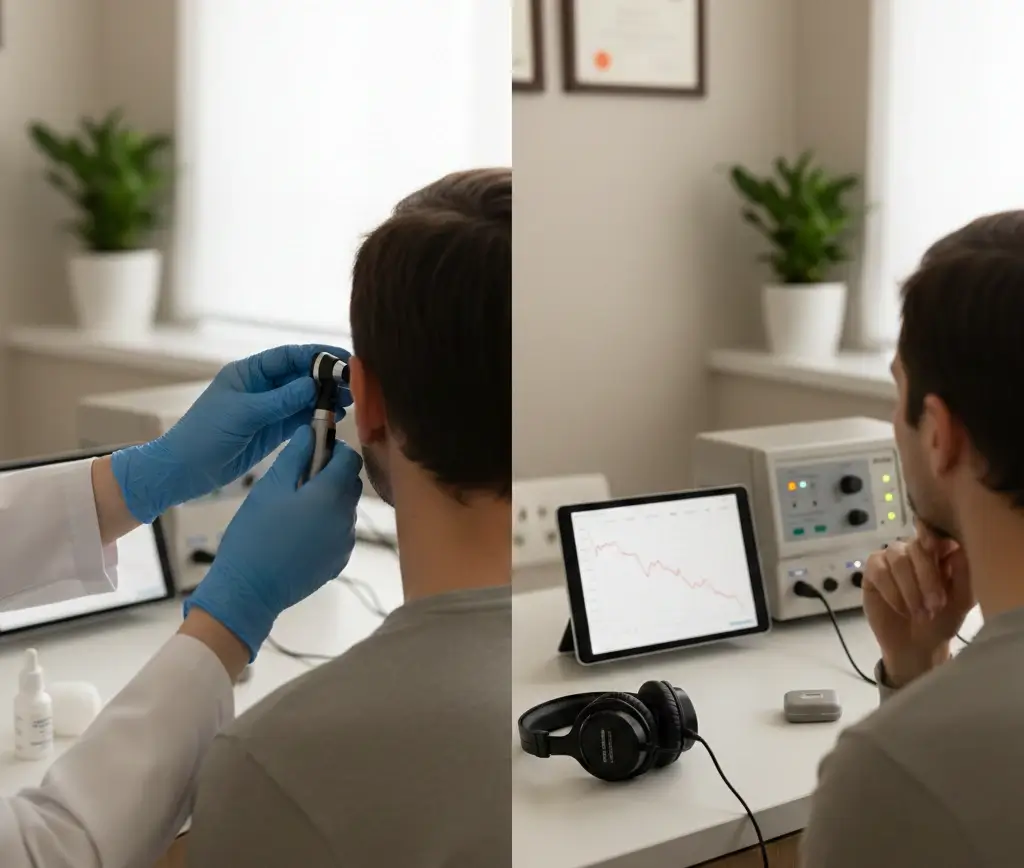
We start with otoscopy. We look into your ear canal to see if there is an obstruction. We can immediately identify wax, inflammation, or obstruction. If it is just wax, we can often resolve the issue right then and there.
Step 2. Middle ear testing:
We use a test called tympanometry. This involves a small puff of pressure. It tells us how well your eardrum is moving. If there is pressure and fluid behind the eardrum, the test will show a flat line, confirming a conductive issue like an infection or ETD.
Step 3. Comprehensive hearing test:
This is the gold standard. We use Pure Tone Audiometry to measure your hearing sensitivity at different frequencies. Using both headphones (air conduction) and a bone oscillator (bone conduction) allows us to accurately distinguish conductive and sensorineural hearing loss.
- If bone conduction is good but air conduction is bad, it is a blockage (conductive).
- If both are reduced, it is nerve damage (sensorineural).
- This provides a clear diagnostic picture and dictates the treatment plan.
Also Read: The Importance of Early Intervention in Hearing Loss
Why Guessing Can Cost You Your Hearing
Taking a wait-and-see approach is a gamble. Temporary blockage is often reversible with simple procedures or time. However, guessing wrong has consequences.
Untreated hearing loss can progress. If the issue is nerve-related, early intervention with hearing aids keeps the auditory pathways in the brain active. Without stimulation, the brain actually “forgets” how to process certain sounds over time, a process called auditory deprivation.
Delayed diagnosis limits treatment options. As mentioned, with sudden hearing loss, time is the most critical factor. Even with a gradual loss, delaying treatment leads to social isolation, cognitive fatigue, and a reduced quality of life. Early intervention significantly improves long-term outcomes, keeping you connected to the people you love.
When to Book a Hearing Test at Discover Hearing Centre
You do not need a referral to get your hearing checked. You should book an appointment if you notice:
- Symptoms lasting longer than a few days: A blocked ear that does not clear after a week needs to be looked at.
- Recurrent blocked ear sensations: If this keeps happening, there may be an underlying issue.
- Any sudden hearing change: This is immediate.
- Ringing or balance issues with hearing changes: These are signs of inner ear involvement.
- Difficulty understanding speech clearly: If the volume is fine but the words are fuzzy, it is time for a test.
If you are looking for a trusted hearing clinic in the Kitchener and Waterloo area, we’re here to help you navigate these symptoms with professional care and advanced diagnostic technology.
Clear Answers for Muffled Ears: Your Next Steps
Uncertainty is stressful, especially when it concerns your senses. If you are unsure whether your symptoms are caused by a blocked ear or hearing loss, guessing is not worth the risk. It might be a simple wax removal that instantly restores your world to full volume, or it might be the start of a hearing journey where early action preserves your connection to those around you.
Discover Hearing Centre provides professional hearing assessments that give you clear answers and peace of mind, so you can take action early and protect your hearing. Book your hearing evaluation today and stop wondering what is really going on.

You Might Also Like

Why Diabetics Should Include a Hearing Test in Their Annual Health Routine

Invisible Hearing Aids: Pros, Cons, Cost, and Who They’re Best For

Can You Trial Hearing Aids Before Buying? What to Know and Ask
Take the First Step Toward Better Hearing
Schedule a Hearing Test Today
Have Questions?
Curious about hearing loss, tinnitus relief, or treatment options in Waterloo? Talk to one of our hearing care professionals today.